Article: Spectrum-Tunable LEDs: How Growers Are Using Far-Red and UV
Spectrum-Tunable LEDs: How Growers Are Using Far-Red and UV
For most of LED history, a fixture's spectrum was fixed the day you bought it. Spectrum-tunable LEDs change that. They split the diodes into separate channels, usually a broad white main channel plus deep red, far-red and UV, and let you dim each one independently from a controller. Spectrum becomes something you schedule by growth stage, room and cultivar instead of a spec you live with.
Far-red and UV are the two channels drawing the most attention right now. This guide covers what each band does, what the research actually shows, how to run a fair trial, and the fixtures, add-on bars and sensors you can build a program around.

What "Spectrum-Tunable" Means
A tunable fixture has two or more diode channels, each with its own dimming signal. A controller sends each channel a level, typically over 0-10V or a digital link, and most controllers let you save those levels as recipes and schedule them through the day or across the crop cycle.
There are two ways to get there:
- Integrated multi-channel fixtures. Far-red and UV diodes are built into the fixture, and each channel is controlled separately. This is the cleanest option for new rooms and full retrofits.
- Add-on bars. Dedicated far-red or UV bars mounted alongside the fixtures you already run. This is a lower-commitment way to trial a band in one room before changing a whole facility.
Far-Red (700-750 nm): Plant Shape and Photosynthesis
Far-red sits just past the traditional 400-700 nm PAR range, and plants respond to it in two ways.
It changes plant shape. Plants read the ratio of red to far-red light through a pigment called phytochrome. A low red:far-red ratio is the signal a plant gets when a neighbor shades it, and the plant responds by stretching. That is why crowded benches and hanging baskets cause stretch in greenhouse crops. A tunable far-red channel turns that response into a lever: more far-red when you want stem elongation or a more open canopy, less when you need plants kept compact.
It works with the rest of the spectrum. On its own, far-red drives very little photosynthesis. Added to shorter wavelengths, it increases it, an effect first described by Robert Emerson in the 1950s. In a 2021 paper in Frontiers in Plant Science, Zhen, van Iersel and Bugbee argued that photons out to 750 nm should be counted as photosynthetic, a range they call extended PAR (ePAR). They also noted that because far-red elongates stems and leaves, the practical far-red share for most crops is likely below about 20 percent of total photon output.
End-of-day far-red is the other technique growers are testing: a period of far-red at the end of the light period, after the main channels switch off. A 2025 study in Scientific Reports on medicinal cannabis found that a 10-hour main photoperiod followed by 2 hours of far-red gave a strong yield and quality advantage over a standard 12-hour photoperiod in the high-THC lines tested, with lower estimated power use. A separate 2026 University of Bologna dataset found that both end-of-day and continuous far-red increased canopy elongation without changing when flowering began. In both, responses varied by cultivar, which is exactly why a channel you can adjust beats a spectrum you can't.
UV (UV-A and UV-B): Promising, but Dose Matters
UV splits into UV-A (roughly 315-400 nm) and the shorter, more biologically active UV-B (roughly 280-315 nm). To a plant, UV is a stress signal, and plants respond by producing protective compounds. That response is why growers are interested in UV as a quality tool.
So far, the research calls for caution rather than hype:
- A 2021 University of Guelph study applied UV-B through flowering and found no commercially relevant benefit to cannabis yield or cannabinoid content. Higher doses reduced the size of the apical buds and damaged leaves.
- A 2023 Utah State University study found that elevated UV had minimal effect on cannabinoid concentration in a high-CBD cultivar, and the highest dose reduced flower yield.
UV is not a set-and-forget potency switch. If you trial it, start low and short, run it in a defined window rather than all day, and watch for leaf curling, bleaching and undersized new growth. The Matrix, Flexstar, Dimlux and ThinkGrow UV bars below emit UV-A. Mammoth's UV upgrade kit adds UV-B, which calls for more conservative dosing. Check each product's spec sheet for exact wavelengths.
Protect your crew. Horticultural fixtures are tested for photobiological safety and assigned a risk group that sets their cautionary markings, and UL notes that the eye is the main concern with UV and high-intensity grow lighting. Follow each fixture's markings and the manufacturer's guidance on eye and skin protection, and schedule UV channels to run when staff are out of the room. Our Safety & PPE collection covers the rest of your crew's protective gear.
Tunable Fixtures at BLACK LABEL
Matrix
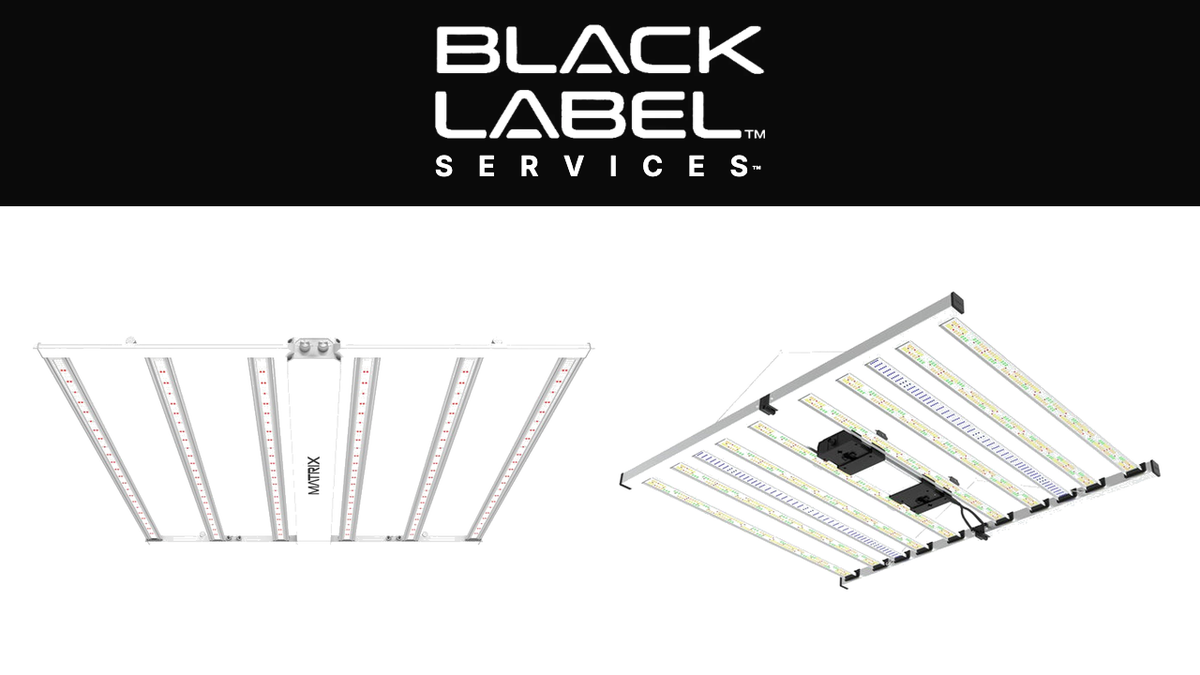
- Matrix M Dyna 4-Channel (Version 2): four independently tuned channels (main, far-red, UV and deep red) in a bar-style fixture, offered as the M6 760W and M8 1000W at 120-277V, plus a 277-480V M6.
- Matrix VEGA Dyna 1000W: a spectrum-tunable top light in the familiar HPS form factor, built as a 1:1 HPS replacement, in 120-277V and 277-480V versions.
- Spectrum tuning on both runs through the Matrix Dyna Control Adapter with a Matrix MC2 or MC5 controller.
ThinkGrow
- ThinkGrow Model One 4-Channel Bar: white, deep red, UV and far-red channels, in 2.5', 4' and 5' lengths.
- ThinkGrow Model One 4' 2-Channel Bar: full spectrum plus a second channel of either deep red or far-red.
- Running a third-party controller? The TrolMaster LMA-9 adapter takes two 0-10V signals so ThinkGrow LEDs can dim their supplemental diodes separately from the full-spectrum diodes.

Mammoth Lighting and Faven
- Mammoth Lighting Nova Sun 10-Bar: three channels, 700W white, 180W UV and 50W far-red, each with its own dimmer on a remote driver.
- Faven Chroma Under Canopy Light: an adjustable R4-R9 spectrum with an independent 15W far-red channel, for tuning light below the canopy. See our Faven announcement and our guide to under-canopy lighting.

Add-On Bars for Fixtures You Already Run
- Matrix FR/UV Bar 18W: far-red (730 nm range) or UV (395 nm range), sold in pairs.
- Flexstar FR/UV Light Bar 18W: 730 nm far-red or 395 nm UV with 0-10V dimming, and daisy-chain capable for full rooms.
- Dimlux Xtreme Series NIR + UV-A Add-On Bar: far-red (670-760 nm) and UV-A (370-405 nm) on two independently adjustable channels, in 70W and 140W, built for Dimlux Xtreme fixtures.
- ThinkGrow UV-1: adds 10W of UV-A alongside 70W of full-spectrum light on ThinkGrow Model-H and Model-W fixtures.
- Mammoth Lighting UV Upgrade Kit: two UV bars with UV-A (400 nm) and UV-B (310 nm) plus a 100W driver, for Mammoth's Mint White series or standalone use.
- Growers Choice UV-R Bloom Booster Set: a dimmable UV bar set that pairs with the Growers Choice ROI-E720.

Measure Before You Tune
A standard PAR meter stops at 700 nm, so it can't see the far-red you add, and it reads nothing in the UV range. To dose these channels, you have to measure them:
- Apogee Instruments S2-141 PAR-FAR Sensor: measures PAR (400-700 nm) and far-red (700-760 nm) together, so you can track the far-red fraction.
- Apogee Instruments S2-131 Red / Far-Red Sensor: measures red and far-red separately to calculate the red:far-red ratio.
- Apogee Instruments P2-141 PAR-FAR + microCache Package: the PAR-FAR sensor paired with a Bluetooth logger for standalone monitoring.
- Apogee Instruments SU-200 UV-A Sensor: measures UV-A to verify supplemental UV output.
Find more in our Light Meters & Sensors collection.

A Simple Trial Plan
- Pick one room or bench and keep a matched control on your current spectrum.
- Change one channel at a time. Far-red and UV both affect plant shape and stress, so testing them together hides which one did what.
- Log the dose: measured intensity at canopy height and hours per day, not just the dimmer setting.
- Track results by cultivar: stretch, leaf condition, yield and lab results.
- Scale what pays off in your facility, and save it as a controller recipe so every room runs the same program.
Spec It With BLACK LABEL
Whether you're adding far-red bars to one flower room or standardizing tunable fixtures across a multi-state footprint, we can help match fixtures, controllers, add-on bars and sensors to your rooms. Approved accounts see their pricing when logged in. For quotes, project lists and procurement support, reach our Commercial Service team at commercialservice@blacklabelsupply.io.