Most greenhouse sanitation programs follow the same loop: a disease shows up, the crew sprays a disinfectant, and a few weeks later the problem is back. A new white paper on commercial greenhouse sanitation argues that the loop keeps repeating because it skips a step. Disinfectants are applied to surfaces still coated in plant residue and biofilm, and those layers protect the pathogens the disinfectant is meant to reach.
This post walks through the white paper's framework, the research it draws on, and how enzymatic cleaning fits into a multi-stage sanitation program for greenhouses and indoor facilities.
Key takeaways
- Organic residue such as plant sap, dead roots and algae makes disinfectants work less reliably. Clean first, then disinfect.
- Irrigation lines, nutrient tanks, floors, drains, benches, climate screens and tools can all hold persistent biofilm reservoirs.
- Surface type, contact time and concentration all change how well a sanitation step performs.
- Enzymatic cleaners such as Enzymes Komplete go between mechanical cleaning and chemical disinfection. They break down residue so the disinfectant reaches the surface.
- The same products can replace isopropyl alcohol and solvents for cleaning light fixtures and harvest equipment, without the fire risk or damage to lenses and seals.
Why disinfectants underperform on dirty surfaces
The white paper, Quorum Rot Syndrome: A Systems-Based Sanitation Framework for Commercial Greenhouse Disease Prevention (Canada Science & Research Institute, July 2026), builds on research from the Vineland Research and Innovation Centre. In that work, published through Greenhouse Canada in June 2026, Vineland tested sanitation products against Tomato Brown Rugose Fruit Virus on greenhouse surfaces. As the white paper summarizes the work, the findings were:
- Organic plant sap increased pathogen resistance to sanitation.
- Organic residues reduced disinfectant effectiveness.
- Cleaning was required before disinfection for reliable control.
- Surface type influenced the outcome.
- Contact time and concentration were critical variables.
Vineland's shared disinfection trials also found that results varied by surface. Of the surfaces tested, climate screen and concrete were the hardest to disinfect. Those two materials are everywhere in commercial greenhouses. According to the manufacturer's addendum to the white paper, the best-performing disinfectant in Vineland's 2026 trials reached full efficacy on cold glass, aluminum and steel only when the surfaces had been cleaned first.

The framework: where disease reservoirs build up
The white paper's framework, called "Quorum Rot Syndrome," treats recurring disease pressure as a system-level sanitation problem rather than a series of separate outbreaks. It describes three stages:
- Organic matter accumulation: sap deposits, dead roots, leaf litter, algae and nutrient residue build up continuously during production.
- Biofilm formation: microorganisms form structured biofilms. Biofilms protect the microbial community, resist sanitation agents and hold residue in place.
- Reservoir persistence: those biofilm zones survive between crops and carry pathogens back into the next production cycle.
The paper lists where these reservoirs form:
- Irrigation lines, drip emitters and dosing equipment
- Nutrient tanks and reservoirs
- Floors and drainage systems
- Benches and structural surfaces
- Climate screens
- Tools and equipment
The paper presents the framework as a complement to plant pathology, IPM and biosecurity practices, not a replacement for crop-specific diagnosis or regulatory guidance. For the pest side of that program, see Building an IPM Program: Scouting, Beneficials, Rotation and Label Compliance.
A five-stage sanitation sequence
The white paper's operational model comes down to one rule: a greenhouse can't be reliably disinfected until its organic contamination has been removed and broken down. The sequence it recommends:
- Mechanical removal: clear plant debris, spent media, leaf litter and standing water.
- Clean organic residues: wash surfaces, benches, floors and drains. A dedicated cleaner such as GreenClean Alkaline Cleaner or GreenClean Acid Cleaner helps with mineral and organic buildup.
- Enzymatic conditioning: treat surfaces, lines and reservoirs with an enzymatic cleaner to break down the remaining plant residue, polysaccharide deposits and biofilm-associated films.
- Chemical disinfection: apply a labeled disinfectant such as SaniDate 12.0 or ZeroTol 2.0, or a hypochlorous acid program such as the HYPO SOURCE Hypo 7.5 generator, at the label concentration and contact time.
- Continuous maintenance: keep sanitation running through the crop cycle, not only at turnover.
The paper names insufficient organic removal before disinfection as the main point where sanitation programs fail. Stages one through three are where most of the gains are.

Where Enzymes Komplete fits
Enzymes Komplete Natural Cleaner is a wide-spectrum natural enzymatic cleaner made in Canada. In the white paper's model, it is the enzymatic conditioning step: it breaks down organic residue and the materials biofilms grow on, so surfaces are ready for disinfection. The manufacturer lists these uses in commercial production:
- Cleaning water pumps, piping, reservoirs and dosing systems
- Cleaning drip emitters and soilless systems
- Reconditioning growing media
- Cleaning propagation and cloning equipment
- Cleaning trimming machines, hand tools and instruments
- General facility maintenance between and during cycles
Enzymes Komplete doesn't kill organisms. According to the manufacturer, it is a bacteria-free enzyme solution that breaks down the organic matter and biofilm matrix that shield them. It doesn't erode surfaces, and it is an environmental treatment for surfaces, lines and equipment, not something applied to the crop.
A note on the evidence: the white paper reports grower-observed improvements in surface cleanliness and reduced organic buildup when Enzymes Komplete is used in a structured sanitation protocol. The paper itself says these are operational observations, not controlled experimental results. In a follow-up addendum, the manufacturer committed to standardized before-and-after measurement, a published case series and independent third-party trials. Use enzymatic cleaning to support your disinfectant program, not to replace it.
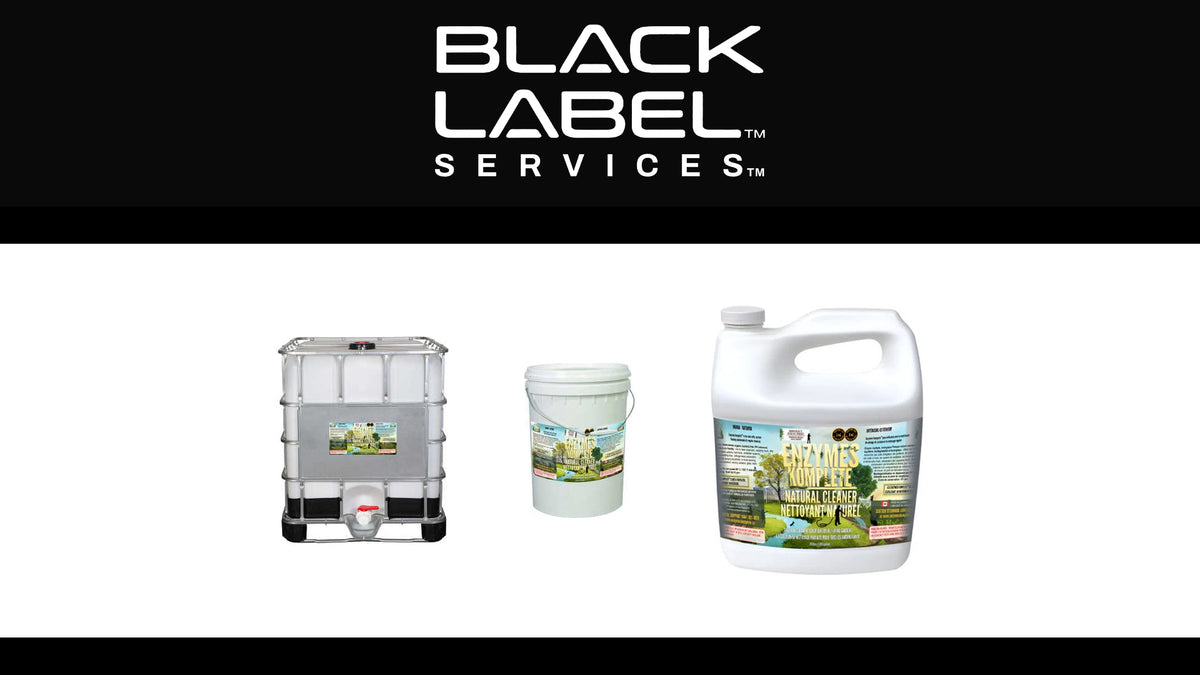
For commercial programs, Enzymes Komplete comes in facility sizes: 4 L (1.05 gal) and 10 L (2.6 gal) jugs, 20 L (5.2 gal) pails and 1,040 L (275 gal) totes. That covers everything from a single room's reservoirs to a full-facility turnover.
Putting it into practice: rates and dwell times
The manufacturer's addendum to the white paper lists the rates and dwell times it has documented in operating facilities:
| Application | Rate | Dwell / follow-up |
|---|---|---|
| Irrigation systems (charged, recirculating) | 2 mL per gallon (about 0.5 mL/L) | 24-hour dwell, then a hydrogen peroxide treatment |
| Trimming scissors and hand tools | Full strength | 15-minute soak, wipe, then disinfect with isopropyl alcohol or hydrogen peroxide |
| Trimming machines | Full strength, sprayed on | Leave 1.5 hours, then wipe off; no pressure washer needed |
| General surface cleaning | About 2 mL per liter of water | Follow with your disinfectant step |
The irrigation protocol comes from a facility working through root-zone disease pressure in a 35-year-old irrigation system. Fabric container cleaning rates are still being refined in ongoing trials.
The addendum is clear that these are starting points, not a universal protocol. Nutrient programs, growing media, facility age, water chemistry, climate and pathogen profile all vary, so parameters need tuning to each site. Its recommended approach for a facility trying the program:
- Start with one system. Pick one irrigation loop, one propagation bench or one tool-sanitation station.
- Record a baseline. Note biofilm presence, disease pressure and current outcomes. ATP swabs or lab counts make results comparable.
- Apply at a defined rate and dwell. Use the starting points above and keep them consistent through the trial.
- Measure after one cycle. Use the same method as the baseline.
- Compare with and without the enzyme step. If you already run hydrogen peroxide or another oxidizer, measuring that system with and without the enzymatic pre-clean shows what the extra step adds.
Cleaning under-canopy and overhead lighting
Dirty fixtures quietly take light away from the crop. A November 2026 field report from the same institute pulls together published lighting guidance putting the loss from fouled lenses and reflectors at roughly 8 to 25 percent of usable output. Under-canopy fixtures get the worst of it: they sit below the canopy, in the path of irrigation splash, sprays, substrate dust and high humidity, and they are the hardest to reach. A method that is slow, hazardous or damaging tends not to get done.
The report questions the default cleaner, isopropyl alcohol (IPA), on three counts:
- It can damage optics. Several fixture makers cited in the report warn against alcohol on polycarbonate and acrylic lenses. The damage is gradual (crazing, hazing, lost transmission), so it can be mistaken for normal LED depreciation.
- It is flammable. IPA is a Class IB flammable liquid with a 53 °F flash point. Sustained wiping across hundreds of fixtures in an enclosed room is the higher-risk scenario.
- It irritates the crew. Repeated exposure irritates eyes, nose, throat and skin.
The report describes a water-based alternative run for many months across a 600-light facility. It took about 30 seconds per fixture, or about five labor-hours for a full pass, with no optic erosion observed and no crew complaints. The manufacturer states the product is non-erosive on plastics and rubber and has confirmed it can be used on unplugged lighting with a rinse and dry. The protocol:
- Lock out the lighting circuit. Confirm fixtures are unpowered and cool. Never clean a live or warm fixture.
- Apply Enzymes Komplete at full strength to a clean lint-free cloth, not to the fixture. Don't spray.
- Wipe the lens and housing in straight passes. Don't scrub diodes or press on emitters.
- Wipe again with a clean, water-dampened cloth to remove residue.
- Towel dry completely. Check lens edges, seals and connector entries for moisture before restoring power.
- Restore power and log the fixture as cleaned.
Suggested frequency from the report: monthly for under-canopy lighting in active rooms and high-aerosol rooms, quarterly for standard rooms, two or three times a year for clean, well-filtered rooms, and immediately after construction, rack changes or an HVAC filter failure. Enzymes are proteins and can be respiratory sensitizers, so the report sets handling rules: apply to the cloth only, never spray or mist, keep normal ventilation running, and wear nitrile gloves and eye protection.
Two cautions from the report itself. The results come from one facility, and light recovery hasn't been measured yet. Some fixture warranties also specify their own cleaning agents, so check your fixture manufacturer's guidance before rolling this out fleet-wide. To measure the benefit yourself, take PPFD readings at fixed points and a fixed height before and after cleaning with a meter such as the Apogee MQ-350 PAR bar. Watch uniformity as well as the average: if the average rises but uniformity drops, cleaning was inconsistent or a lens is damaged. For more on the fixtures themselves, see our post on Faven Chroma under-canopy lighting.
Cleaning harvest and processing equipment
Harvest and processing machines run in constant contact with plant material, oils, resins and proteins. That buildup fuses to blades, combs, screens and housings, and inside moving mechanisms it can throw off alignment, wear parts faster and interrupt production. Solvents are the usual answer, but the field report notes they can soften or attack non-stainless parts such as gaskets, O-rings and pipes. Pressure washing can force water past seals into bearings and motor housings.
Enzymes Komplete's equipment-cleaning brief lists trimming equipment, cutting blades, machine parts, hand tools, rubber gaskets, soft plastics, metal parts, pipes and nozzles as applications. The method is dwell-and-wipe rather than scrub-and-blast. See the rates table above for scissors, hand tools and trimming machines, then:
- Apply to the equipment or components, matched to how heavy the buildup is.
- Allow dwell time for the enzymes to break down the organic material, and don't rinse early.
- Wipe off the loosened material with a clean rag. No pressure washer needed.
- Repeat where heavy buildup remains.
- Sanitize with your facility's approved procedure for that equipment. Hydrogen peroxide or isopropyl alcohol on tools; the report advises against bleach and chlorine on tooling because of corrosion.
Based on its own testing and field experience, the manufacturer reports that the product removes resin and organic buildup without leaving a damaging residue, with no erosion observed on the equipment it tested. It describes the product as natural, non-GMO, bacteria-free and biodegradable. Confirm dwell times and dilutions against the current product label before writing them into an SOP, and test on one component first.
FAQ
Do I still need a disinfectant if I use an enzymatic cleaner?
Yes. In the white paper's model, enzymatic conditioning comes before chemical disinfection, not in place of it. The enzyme step breaks down residue so the disinfectant can reach the surface at its labeled concentration and contact time.
Is an enzymatic cleaner applied to the plants?
No. According to the manufacturer, Enzymes Komplete is an environmental treatment for surfaces, irrigation lines, tanks and equipment. It breaks down organic residue and biofilm rather than killing organisms, and it isn't applied to the crop.
Why clean before disinfecting?
The research summarized in the white paper found that organic residue such as plant sap protects pathogens and reduces disinfectant effectiveness. Removing that residue first makes the disinfection step more reliable.
Which surfaces are hardest to sanitize in a greenhouse?
Vineland's disinfection trials found that results varied by surface, with climate screen and concrete the hardest to disinfect effectively. Give those surfaces extra attention in cleaning and contact time.
Where do biofilms usually build up?
Irrigation lines, emitters, nutrient tanks, floors, drains, benches, climate screens and shared tools. These are the main targets for the enzymatic step during room turnover and routine maintenance.
Always follow the product label and SDS for every cleaner and disinfectant, and your facility's own safety program, including the PPE the label calls for.
Sources
- Morrison, J. J. Quorum Rot Syndrome: A Systems-Based Sanitation Framework for Commercial Greenhouse Disease Prevention. White Paper Series: Greenhouse Infrastructure Sanitation. Canada Science & Research Institute Inc., July 3, 2026 (framework developed March 2026).
- Enzymes Komplete Holdings Ltd. Addendum: Responding to Questions About Evidence and Application. Quorum Rot Syndrome White Paper Series, supplementary response, 2026.
- Morrison, J. J. Cleaning Under-Canopy Lighting and Harvesting Equipment. Road Warrior Report. Canada Science & Research Institute Inc., November 15, 2026.
- Enzymes Komplete Holdings Ltd. Enzymes Komplete Natural Cleaner Signature Detergent (equipment-cleaning brief), 2026.
- Hendricks, K., & Buitenhuis, R. "Fighting Dirty: New Tools in the Battle Against Tomato Brown Rugose Fruit Virus." Vineland Research and Innovation Centre / Greenhouse Canada, June 30, 2026 (as cited in the white paper).
- Vineland Research and Innovation Centre. Rugose Disinfection Shared Trials.
- Enzymes Komplete. Preparation & Use and Machinery, Equipment & Hand Tools Cleaning.
Need help building a sanitation program, or pricing Enzymes Komplete alongside your disinfectants for a room turnover or full facility? Email commercialservice@blacklabelsupply.io for a quote. Approved accounts see their pricing when logged in. You can also browse the full Disinfection & Sanitation collection.